
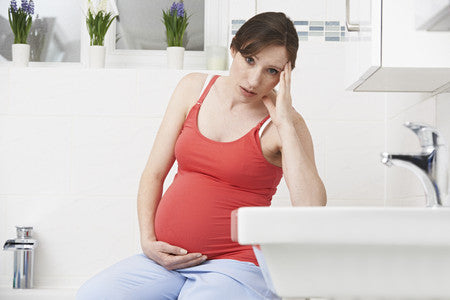
Good News For Women Suffering From Severe Morning Sickness

Almost every woman who's been pregnant has experienced a periodic bout of morning sickness.
For some women, morning sickness is something they have to battle with every single day. It's usually quite debilitating and it's definitely not fun to experience.
Other women seem to get lucky and they skate through pregnancy without having to deal with overwhelming nausea or other symptoms associated with this daily condition.
According to research published on the subject, "Around 50 percent of pregnant women simply feel nauseous, but roughly half will also experience vomiting. A rare few, perhaps 1 in 100, are so sick that they require hospital treatment."
Well, if you're a woman who has dealt with morning sickness (or you know a pregnant mom-to-be who's going through the worst of it), you can tell them morning sickness might actually be good for their child.
A recent study concerning morning sickness and subsequent health of their child has produced some pretty surprising results.
According to NICHD research, morning sickness might help prevent a later loss in pregnancy.
The reasons why women suffer morning sickness are still unclear. Right now the most popular theory is, since the symptoms first start to appear around the third month of pregnancy, it's the body's way of protecting the child by deterring the mother from eating foods capable of damaging it during that stage of development.
Since the third month is one of the most influential in terms of development, researchers think morning sickness is the body's natural defense against the accidental introduction of potentially destructive influences.
In the study, researchers noted that women who had severe nausea and vomiting were much less likely to lose their child.
According to Medical News Today:
"[The team] used data from the Effects of Aspirin in Gestation and Reproduction (EAGeR) trial. EAGer was designed to test the effects of low-dose aspirin on women who had experienced one or two pregnancy losses in the past.
The EAGer trial consisted of 797 pregnant women. In total, 188 pregnancies ended in loss. By the 8th week, 57.3 percent of women reported having experienced nausea, and 26.6 percent reported experiencing nausea and vomiting.
Analysis of the data showed that the women who experienced morning sickness were 50-75 percent less likely to experience pregnancy loss than those who had neither vomiting nor nausea."
This lead the lead researcher Stefanie N. Hinkle, Ph.D. to write the following in a published report:
"Our study evaluates symptoms from the earliest weeks of pregnancy, immediately after conception, and confirms that there is a protective association between nausea and vomiting and a lower risk of pregnancy loss."
This study demonstrates what many people have thought all along: morning sickness, though miserable, might actually be good for the baby.
Of course, whenever I write about such a study I need to caution we can't make firm conclusions about the veracity of these statements.
This study was quite small and it's important to realize we'll need much larger studies in the future to make any kinds of firm conclusions.
Talk soon,
Dr. Wiggy
www.HealthAsItOughtToBe.com
Related Posts

Answered - Serious Questions about Our New Breast Scan
For the last couple of weeks, I’ve talked about breast cancer risk, breast density, supplemental imaging, and why we invested in QT Breast Acoustic Ultrasound.
Now I want to make this much more practical. As I’m sure many of you are wond...
Read More
20 Minute Exercise Can Help Alter the Gut
The gut is the second brain.Or, it’s been called that.We know how important the gut is, and it’s encouraging to know a simple walk can positively affect it. Because constipation is so common, this is great news. It can mean bloating, str...
Read More
Why We Spent BIG $$$ on This Breast Imaging Machine
One of the most amazing things about the 20th and 21st centuries is that technology lets us see inside the human body.For millennia, if you were ill, there was no way for a person’s insides to be exposed to find out what was going on.Tha...
Read More